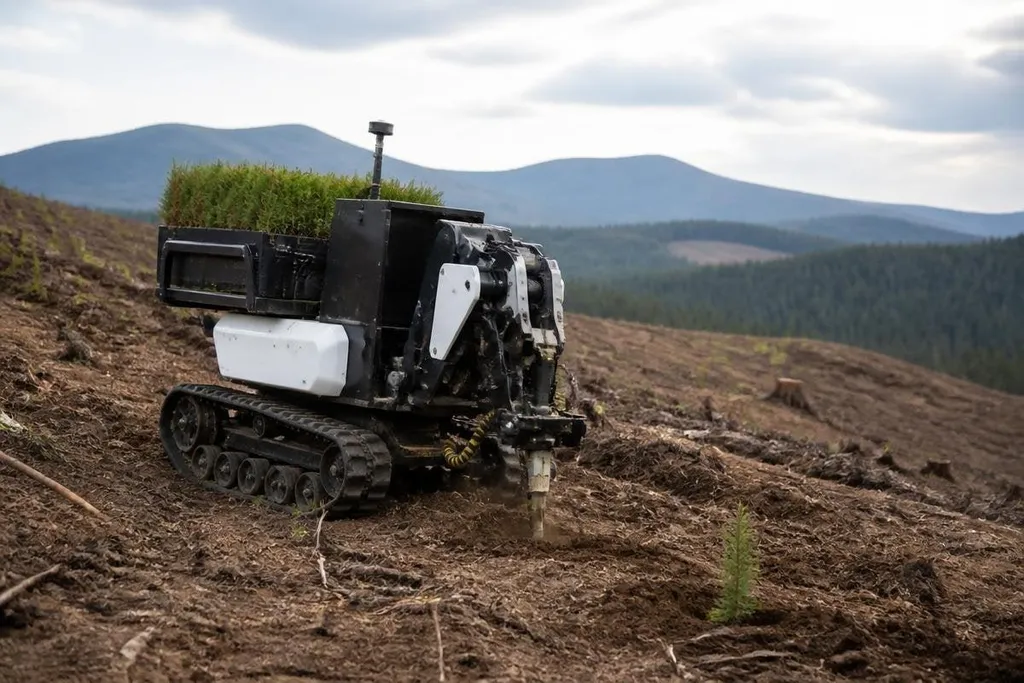
Tree-planting robots are being developed for work that is slow, tiring, and spread across difficult terrain. Their value depends on more than how fast they place a seedling: the machine must put the tree in the right soil, protect it, and leave it able to grow.
- Robots can carry out repeated planting tasks across large sites.
- Sensors can help place seedlings at set depths and spacing.
- Human crews still need to plan sites, check trees, and handle failures.
The work robots can take on
Planting a tree involves more than making a hole. A crew may need to move seedlings, prepare soil, place each plant, firm the ground, and mark the location for later checks. A robot can combine some of these tasks in one pass, depending on its design.
The machine may use wheels, tracks, or legs to move between planting points. A planting tool can open the soil, place a seedling, and close the hole. Cameras, LiDAR, or other sensors can help the robot avoid people, rocks, stumps, and uneven ground.
That does not make every forest site suitable. Loose soil, steep slopes, dense brush, and hidden roots can stop a machine that works well on a prepared plot. A robot built for flat farmland may need a different frame, drive system, and planting tool for a damaged forest.
Why timing and labor matter
Planting work is often tied to weather and soil conditions. Crews may have a short period when seedlings have a better chance of surviving. If work takes too long, the site may miss that window.
Robots can handle repeated movement during that period, while people focus on site checks, machine recovery, and planting tasks that need judgment. The benefit comes from sharing the work, not removing people from it.
Labor also affects where planting can happen. Remote sites take time to reach, and difficult ground can make each planted tree cost more in effort. A machine that carries its own seedlings and tools could reduce some walking and lifting, but its transport, charging, repair, and supervision still count in the total cost.
Those costs need field evidence beyond a product page. Tree-planting robotics reports can tie a robot’s planting rate to terrain, travel time, seedling type, and human work left after each run. The next question is harder: can the trees survive?
The hard part is keeping trees alive
A planting robot can place a seedling correctly and still fail its purpose if the tree later dries out, gets eaten, or loses contact with the soil. Planting quality must be checked against survival, not only against the number of holes completed.
The robot may need to record where each tree was placed. That map can help crews return for watering, protection, inspection, or replacement. A location record also gives operators a way to find patterns when trees in one soil type or slope position fail more often.
The open problem is site variety. A robot may need to recognize soil changes, adjust planting depth, and stop when the ground is unsafe to enter.
Those decisions require field data and careful testing across seasons. A short demonstration cannot show whether a system keeps working after dust, rain, vibration, and repeated tool contact with stones.
I'd back tree-planting robots for repetitive work in prepared areas, but I'd skip any plan that counts planted seedlings without checking survival.
A practical decision guide
Before buying or funding a tree-planting robot, check these points:
- Site shape: confirm the machine can move across the steepest slopes, soft ground, and narrow paths.
- Planting method: check the seedling size, hole depth, spacing, and soil-closing process.
- Human control: set out who supervises the robot and who responds when it gets stuck.
- Tree records: require location data that crews can use during later inspections.
- Care plan: budget for watering, protection, replacement planting, and machine repair.
- Success measure: track tree survival after planting, not only daily machine output.
That last measure changes the buying decision. A slower system that places fewer seedlings but leaves more trees alive may serve a restoration project better than a faster machine that needs heavy replanting.
These robots are becoming more useful as a way to extend human crews into repetitive field work. Their next test is clear: can they keep planting quality high across real ground, through a full growing season, at a cost the project can carry?